Rachael Blackmore
Just Rachael
Of all the labels foisted upon her, the woman from Killenaule just wanted to be herself and do her job, in the process becoming one of the greatest jump jockeys and Irish sportspeople of all time
Photos: Caroline Norris • Words: Daragh Ó Conchúir
“People think that only men can have warrior hearts but women can have warrior hearts too” – Katie Taylor
Rachael Blackmore is wolfing down a toasted sandwich but even in this notoriously messy pursuit, one of racing’s greatest jump jockeys looks neat and tidy.
The refuelling completed, Blackmore throws herself equally enthusiastically into 70 minutes or so of prodding and probing about her career. It is a fascinating experience, watching her wrestle with topics in real time, still unsure as to her thoughts or opinions in some areas, teasing them out, tossing them around in her head. Processing.
When a high-performance athlete operating at the very sharp end of her trade, she taught herself to be tunnel-visioned. It is a common trait among achievers.
Ruby Wash, AP McCoy or Ryan Moore only had to answer questions about horses and winning races, however. Blackmore was a pioneer and what comes with that can be ruinous if not managed. So she dealt with it by putting on the blinkers, polite but firm. She was there to do a job, the same as anyone else.
Tunnel vision doesn’t allow for nuance or too much emotion. But the mindset that she was renowned for is not required now in her new daily life. And so, in a bid to be honest, she grapples with what you confront her with, from a perspective that is evolving, gradually. “This is my first big interview,” she explains. “I’ve talked at sponsors’ gigs and things like that, but I haven’t actually had someone try the get-inside-your-mind thing yet.” It makes what unfolds absolutely credible, sincere, and transparent. Authentic.
When Blackmore called time in trademark no-fuss fashion in May, a couple of months shy of celebrating her 36th birthday, she had no idea what lay in store for her.
There have been holidays and concerts. She has mixed it with the elite in the royal box at Wimbledon and with nobility of a different kind when posing for photos with Paul Mescal in a BBC corporate box at Croke Park.
She arranged a meeting at the RDS between two important steeds in her life, 2022 Gold Cup winner A Plus Tard, and Tommy, the pony that provided her with a first ever winner in Clashmealcon, Co Kerry 18 years earlier. A 13-year-old by the name of Paul Townend lost out in the driving finish that day.
There are plenty of commercial engagements, a number of charitable ones too. She helps on the farm at home in Killenaule. She even formed part of a Horse Racing Ireland delegation to Dáil Éireann at the end of September.
They say sportspeople die twice but Blackmore wasn’t forced to retire. She is happy it was the right decision. That doesn’t mean she isn’t mourning her former life.
When her velvet hands, cool calculation and innate genius smuggled Bob Olinger to victory in the Stayers’ Hurdle last March, she became only the fifth jockey to win all four championship races at Cheltenham, having scored twice in the Champion Hurdle with Honeysuckle (2021, 2022), landed that Gold Cup with A Plus Tard and the Champion Chase with Captain Guinness (2024). The same quintet – Richard Johnson, Ruby Walsh, Barry Geraghty and Paul Townend being the others - also secured the only other open Grade 1 at the festival, the Ryanair Chase. Blackmore scored with Allaho (2021) and Envoi Allen (2023).
Only four of this group have added the Grand National– Johnson, the one to miss out. Blackmore did it with Minella Times in 2021, a month after being leading rider at Cheltenham.
Of course she was the first female to do all these things, individually and collectively. Such shattering of glass ceilings was and is important but it always felt like a responsibility she could do without. And as the CV became ever more stacked, her sex sometimes clouded the exceptional nature of her achievements in their totality.
Think of the deserved level of recognition for Rory McIlroy joining the elite of golf by winning the Masters and cementing the career Grand Slam. He is on a pedestal for all time. The same applies to Blackmore. Not because of her gender, but because of what she actually won and how few in her male-dominated sport have matched it.
Her dreams were to ride a winner. To be champion female point-to-point jockey. Maybe lose her claim.
But as she sits before me now, she is one of the most recognisable faces in racing, with a mural outside Tipperary Racecourse, a BBC Sports Personality of the Year gong, an MBE and the likes of Ringo Starr and Billie Jean King as avowed fans.
All the time, she has remained level-headed. Personable. No bull. No need for a surname either. Just Rachael. She is busy but riding out in her familiar racing yards at Knockeen (Henry de Bromhead) and Closutton (Willie Mullins) has not been part of the routine.
“I went into Willie’s about three weeks after I retired to ride out, and I was like, ‘What am I doing here? There’s no purpose to me being here.’ So I haven’t ridden out since. I imagine over the winter I will again, when I have a reason to do it. For the summer anyway, I had no purpose doing it. It just felt strange.
“I didn’t retire thinking I want to be a trainer, or I want to be head of this, or I want to be a nurse, or I want to be teacher. I was living such a fantasy life, being a jockey so long, that I never allowed myself to think, ‘What am I gonna do when this is over?’ And now I’m thinking about that… there’s no major plans but I’ll always be involved in horses here and there.” She stunned us all with that retirement on May 12, announced a couple of days after piloting a winner, Ma Belle Etoile in Cork, on what proved to be her last engagement.
She did not set foot on a racecourse again until August 9, when a new commercial ambassador role with FBD Hotels and Resorts brought her to Curragh Racecourse. It wasn’t jump racing, which made it easier.
But it wasn’t easy. It really struck home when standing in for a presentation photo. She wanted the ground to swallow her up.
“I just have to get over myself obviously,” she says wryly. “But look, at least it was my job to be there that day. I can’t see myself being at the races socially. That’s a long time away. It’d be too hard, I think, because I wanna be in the weigh room.
“It’s not because I didn’t love riding anymore that I stopped. I miss riding, and I love (present tense) when you get to the races, you can just go into the weigh room and that’s your job, and it’s a class job to be doing.”
So why retire?
“It genuinely just felt like the right time for me to do it. I’ve been so lucky at Cheltenham the last couple of years and the Tuesday, I’ve always had a winner. So this year, the first two days, there was nothing happening, and I remember going to bed on Wednesday thinking, ‘I’ve been so lucky here, it just mightn’t happen this year. This is normal.’
“And then Thursday happened, two winners. And I just remember thinking I was so lucky. ‘How long can this keep going on for?’ Then, when I was leaving the weigh room on Friday, I felt so grateful that Thursday happened and I had this moment. I looked back at the weigh room, and I thought, ‘God, will I be back here next year?’
“And then I was like, ‘Yeah, I will!’ But it was the first time a seed of doubt was kind of put in my head.”
She had a giggle to herself when returning a month later to win on Theatre Native, but by then, had resolved to place the retirement seed in an envelope in a drawer, somewhere at the very back of her mind, until the June holidays.
This is the main reason the retirement did not happen at Punchestown. Another is that being the personification of humility, she would abhor the inevitable scale of publicity. But there is one more.
“I feel like Punchestown every year, somebody says it to me: ‘Are you retiring?’ Especially since Honeysuckle retired. And I never was. Back when Honeysuckle retired, I was nowhere near retiring in my head. I had ten years left. Even this year, one or two people said it to me. “I’m not knocking the people who have done it that way. How unreal was it for Katie (Walsh) and Nina (Carberry) to do it on a winner at Punchestown? That was class. And it would be weird if Ruby didn’t do it at Punchestown. So everyone is different.
“But for me, it was that I just had to listen to it every year I went there, and I was just like, ‘If I’m lucky enough to get to decide, it’s not going to be at Punchestown. I’ll even just ride for one more day.’ It just annoyed me. Because I wasn’t ready.”
And then suddenly, she was. Reporting in The Irish Times on that Cheltenham Thursday, where Blackmore delivered Air Of Entitlement to win the Mares’ Hurdle before treating us to an exhibition of nerve, class and intelligence in writing yet more history with Bob Olinger in the Stayers’, Brian O’Connor utilised the line about form being temporary and class permanent.
He was alluding to Bob Olinger. But given the preamble, it felt appropriate for Blackmore too. The season had begun swimmingly with 24 winners in 144 rides, a strike rate that had her tracking for one of her best seasons ever numerically (92 in that annus mirabilis of 2020-21 and 90 in 2018-19, both campaigns at the end of which she finished runner-up to Townend in the jockeys’ championship). It was early, but she was flying.
Then came the broken neck with Hand Over Fist coming down when leading and going best at the penultimate obstacle of a 0-109 handicap chase at Downpatrick.
“I broke my C2 (vertebrae). It’s a tiny little bone, but it’s just where it’s positioned. it’s just one down from C1 obviously, so it’s a really dangerous place to damage.
“I stupidly kept convincing myself I was going to be back sooner than I was. Previous injuries I’ve had, you can kind of prove to the doctors you’re okay and you’re working really hard with physio and gym and you get back quicker but there was no grey area here. They didn’t care how much I wanted to get back and they didn’t care how well I felt, or how good my movement was, or how much I was doing to strengthen it. They didn’t care. When it’s your neck, it’s 12 weeks. It’s too critical a bone to play with.”
Thanks to the high level of medical support available to Irish jockeys, there were no delays and she did manage to marginally beat the deadline, with the approval of another consultant. When she got back after three months on the sidelines at Naas, she was entitled to be a little rusty. In her absence, Darragh O’Keeffe had surfed the same de Bromhead wave that had carried her through the summer.
Now though, Knockeen was hitting a lull. It took Blackmore two weeks and 17 rides to get off the mark and though de Bromhead stated categorically that she was his No 1, the bookings spoke of more owners preferring to go with O’Keeffe.
On a human level, you presume this must have hurt, but the ever-pragmatic Blackmore insists it was inevitable.
“When I came back, it was hard, you know? It was hard. But I feel like I maybe didn’t get myself 100% back to where I was, but I got myself a good bit back to where I was.”
Misunderstanding, I ask if she means physically or mentally. She doesn’t mean either.
“No, just in my position in the yard. But that’s what happens. Being out for that long, you cannot expect things to be exactly the same as before. That’s just the world of racing. I was in a great position that I had Grade 1 horses to come back to.”
Were she a different character, Cheltenham might have felt like a metaphorical up yours to the doubters. She kept her counsel, before and after displaying that legendary mental acuity to deliver when it mattered most. Bob Olinger would provide her with the last of 33 Grade 1 career triumphs, on the same sward that Minella Indo supplied the first only six years earlier.
You cannot hide at Cheltenham and Blackmore was centre stage in that golden period, accumulating 18 festival winners. Eighteen. That, by the way, was her total career tally of winners as she celebrated her 26th birthday.
Let the enormity of that sink in.
All but three of those 18 Cheltenham winners were Grade 1s. This was her playground, her Broadway. Some wither under the glare of the sun. Champions bloom.
There were some disappointments at Prestbury Park. After becoming champion conditional in Ireland, she was prevented from participating in the Martin Pipe Hurdle for conditional jockeys by an age limit of 26.
“I think that rule is gone now. I did try to change their minds and sent a strongly worded email but it didn’t work.”
There were falls and beaten favourites but the worst reverse was the loss of the 2021 Gold Cup. It left a slight pall on a remarkable four days that concluded with six winners. Only Walsh has ridden more, with seven.
De Bromhead saddled two leading contenders. A Plus Tard provided Blackmore with her first Cheltenham winner in 2019. Minella Indo gave her a first career Grade 1 three days later. Now, she had to choose between them in the blue riband of her sport. The stakes could not be higher. You could say she chose wrongly, getting close but not close enough to Jack Kennedy and Minella Indo. The devastation was writ large all over her face.
Walsh loved that reaction. He understood it, having gone with Kauto Star over Denman in 2008. To his mind, if you wanted a summation of what makes a winner, it was that reaction to losing, at the end of one of one of the best weeks numerically that any jockey had experienced in the history of the Cheltenham Festival.
In the aftermath of the redemptive 2022 renewal, when she became the first jockey since McCoy in 1997 to win the Gold Cup and Champion Hurdle in the same year, she revealed that her devastation 12 months earlier was down to her belief, not that she had chosen wrongly, but that she had gotten it wrong in the race.
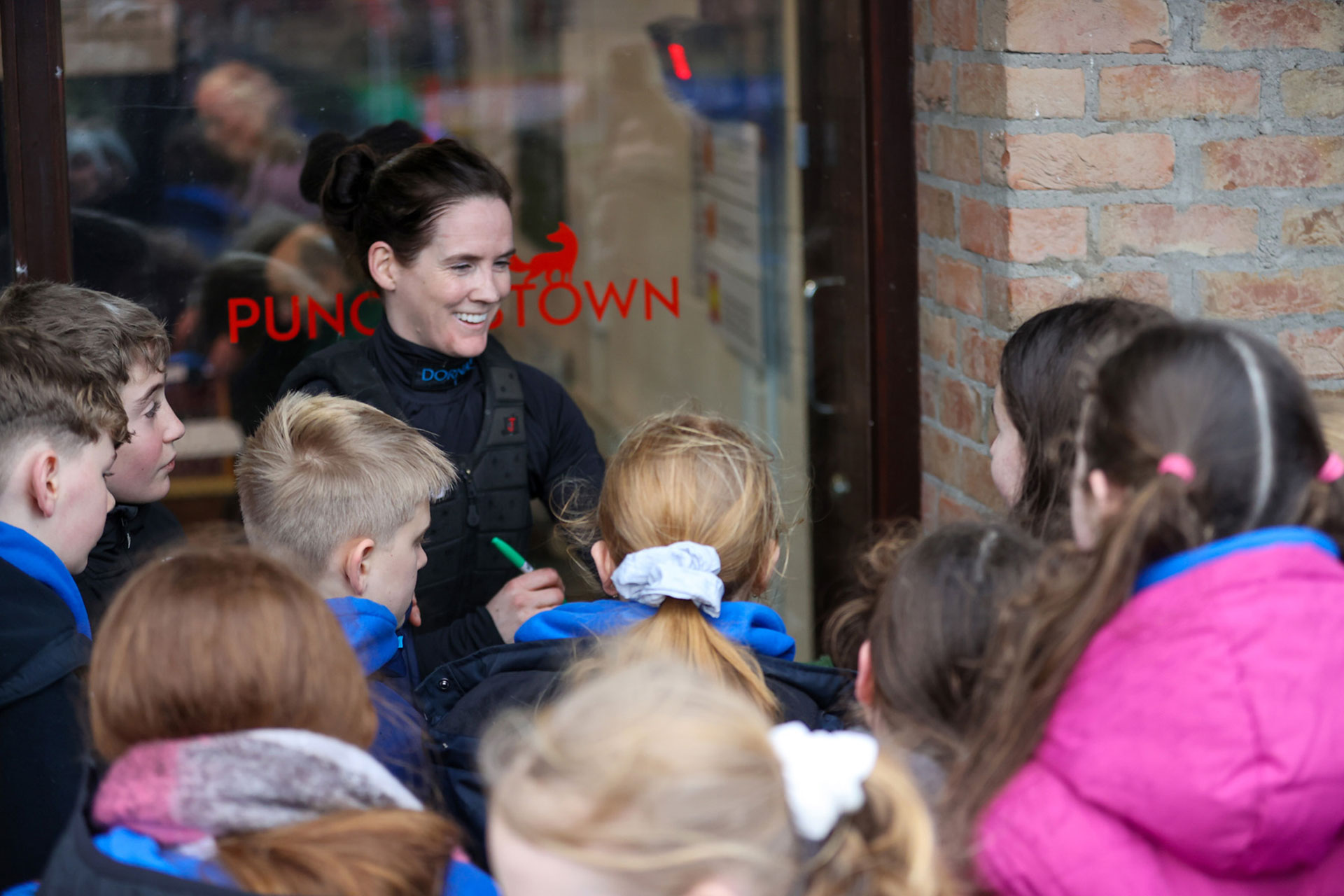
She always gave her time to children on the track and off it, but what was very evident was that she was a role model for both girls and boys
“Every jockey is going to be like that. You have to try and figure something out. But the way he won the second year, I feel like I could have given him any ride. He won so well. But you’re not going to finish second and… sometimes there isn’t anything you could have done but a lot of times there is.”
Sometimes, you give them a great ride and finish second.
“Exactly, but I just knew in that instance, I hadn’t.”
Try to flip it and find out what she views as her best ride and you hit a stone wall as Blackmore attributes what might have looked good to the calibre of horses she rode, and to a trainer that always had his horses primed for national hunt’s Olympics especially. “There’s no coincidence that I had success in Cheltenham when I was riding for Henry de Bromhead. He’s just incredible at peaking his horses for Cheltenham. It’s insane… He’s just incredible at nailing Cheltenham. I was so lucky that I was part of that team.” A 0-116 handicap chase on February 28, 2016, is a race that stands out as significant in her career, however.
“I find it kind of funny became of the name of the horse, but I was riding in a Martinstown Opportunity race (for conditionals). The horse’s name was Mr Goodenough, and he won. John Robinson bred, owned and trained him.
“And this is it in my head.
“Now, maybe Garry Cribbin, my agent, will say different. But he won that chase in Leopardstown, and he was a brilliant jumper, but it was a big deal riding a winner over fences in Leopardstown. And I think after that race I started to get a few more outside rides, more of a Gigginstown connection. I do think that winner kind of moved things a bit.”
That Gigginstown link led to the de Bromhead connection and very quickly, she was travelling to Cheltenham with a number of chances of not just running well, but winning. There was pressure with that but in 2019, Blackmore relished every bit of it.
“You’d love it. Going out to ride A Plus Tard and he was favourite for that handicap. And sure he hosed up. But you felt great. You were in Cheltenham with a chance. Yeah, there was pressure but it’s what you wanted. You wanted to be there. I’d had rides in Cheltenham with no pressure so this was good to have.
“And the manner in which he went up the hill, and it was the same when he won the Gold Cup, it’s just phenomenal. It was like somebody just landed him in after the last. Obviously, he was a Gold Cup horse in a handicap, but that moment of, ‘I am now a Cheltenham Festival-winning jockey.’ That was just class. That was unreal.”
It was the Grand National that sent Rachael Blackmore stratospheric. She felt the difference herself in terms of that immediate envelopment of her body in euphoria as she passed the winning post on Minella Times.
“At Cheltenham, I feel like a lot of my winners could have been winning. As in, I was riding very good horses for Henry de Bromhead. So even if they were a slightly bigger price, they still are there with a chance because he doesn’t mess around at Cheltenham. And obviously, with the ones who are favourites, there’s more pressure. So the first little instinct is relief.
“But the National is so different. You don’t feel that. The minute you cross the line, it’s just incredible. There’s no pressure, no relief, it’s elation straight away.
“I really got a feel for the global scale of the Grand National. I was after coming back from six winners at Cheltenham and that was incredible. But after the Grand National, it’s a whole different ballgame. Congratulations from all the different parts of the world. It is the race that people watch.
“You cannot hide at Cheltenham and Blackmore was centre stage in that golden period, accumulating 18 festival winners. Eighteen was her total career tally of winners as she celebrated her 26th birthday”
“You never really think as a jockey you’re going to be the one that wins it. I mean, I couldn’t wait to ride Minella Times. But there’s no pressure being put on me. The green and gold are great colours to ride for. Henry doesn’t give instructions – for once! It’s different. But he’s such a good jumper. So I was really looking forward to riding him.” “A lot of people are born with a special talent and they don’t necessarily get to where they want to be. But whenever I needed to meet the right person, they came into my life and helped me reach the next level” – Peter Schmeichel “Sometimes it’s easier to just say nothing” – Rachael Blackmore Blackmore refers to being lucky 25 times during the conversation. For all the talent and graft, there is a significant element of luck, in the genesis of the story particularly. In Davy Russell, who had seen her riding out at Pat Doyle’s, putting a word in with Shark Hanlon, who was seeking a competent jockey to land a punt with Stowaway Pearl at Thurles on February 10, 2011. Hanlon spared her knowledge of the gamble but she delivered.
That’s the thing about luck. It only brings you so far. At some point, it comes down to you. There was a fair degree of fortune too in Hanlon making the leftfield suggestion that she turn professional. She had ridden the grand total of 11 point-to-point winners and seven under NH rules. There had not been a female professional for 30 years since Maria Cullen, now best known as the groom of Marine Nationale.
The logic, of course, was that with a claim and an ability to do light weights, she would at least be busy. Many industry people thought it was insanity. Particularly for a woman. The primary concern was her physical endurance. She was surprised but emboldened.
“When you got someone who says, ‘I want to get behind you,’ it’s exciting. It’s a bit of excitement. And I was leaving nothing behind. It was unusual, but there was no real decision. It was just like, like, ‘Why not?’ I had nothing to lose. Nothing to to lose.
“My genuine ambition back then was to lose my seven-pound claim. That was never going to happen staying amateur.”
As her achievements accelerated beyond that initial target, Blackmore was constantly queried about being a role model, about being a woman in a man’s world, about the biases of old and whether they still lingered.
It often exasperated her. The quote she provides at the top of this section came in a piece on ITV, in which her body language could not express any more disinterest in and discomfort with the gender topic. It looked the bane of her life.
“I never wanted anyone to perceive me as different. So I was like, ‘If I’m standing here in interviews, highlighting the fact that I’m different, I’ve done this as a female,’ I just never felt like that would benefit me, trying to be treated the same.
“I fully appreciate how I’m so lucky and privileged to be the first woman to have done these things. So that’s a bit different but by 99% of people, I was treated like a normal jockey. I didn’t see the need for my gender to be a highlighting factor in conversations of my achievements.”
What about now? Removed from the cauldron?
“I know what you’re saying. Now, have I…? Am I now happy to speak about it? And I kind of should be happier to speak about it, but I’m like… I suppose I just don’t have much practice yet thinking about it.
“But I don’t see what I achieved as being any better because I’m a girl. You will always get one or two per cent of people for who the gender is gonna get in the way and that’s just the reality of it.”
The figure is that low?
“Maybe I’m being kind to them. But it’s only the odd person. They are out there. And, you know, it’s probably more an angle of, ‘You’re not strong enough,’ rather than it’s your ability. You’re not strong enough because you’re a female. And look, you’re never going to be able to change that.
“I feel like this is another area that I’m working out. I’m still getting my head around it and how to articulate that. But when I was riding, I didn’t want to highlight it, because if I was highlighting it, then you’re the owner, and you’re thinking, ‘She is different.’ But I didn’t want anyone to think I was any different. We’re all passengers on these horses and some of us get to ride the better ones. You’re trying to be this passenger that doesn’t mess up and that’s the crux of it.”
What is inarguable is that her supreme skills would have gone unutilised, undeveloped, unknown to everyone, herself included, but for Hanlon’s ingenuity. We would still be waiting for a woman to tick off that catalogue of achievements.
Is there a pathway now? Will we see a new crop of girls coming through?
“There’s plenty of lads out there who aren’t making it too. I feel like there’s definitely a stronger pool of males that want to be a jump jockey. And that’s just the way it is. I do think, maybe it will take a few years for the effect of my success in the Grand National in 2021, for those girls to grow up. I don’t think it’s going to be overnight.”
There would be no more fitting legacy for someone who was superhuman in the saddle, but is just Rachael out of it.
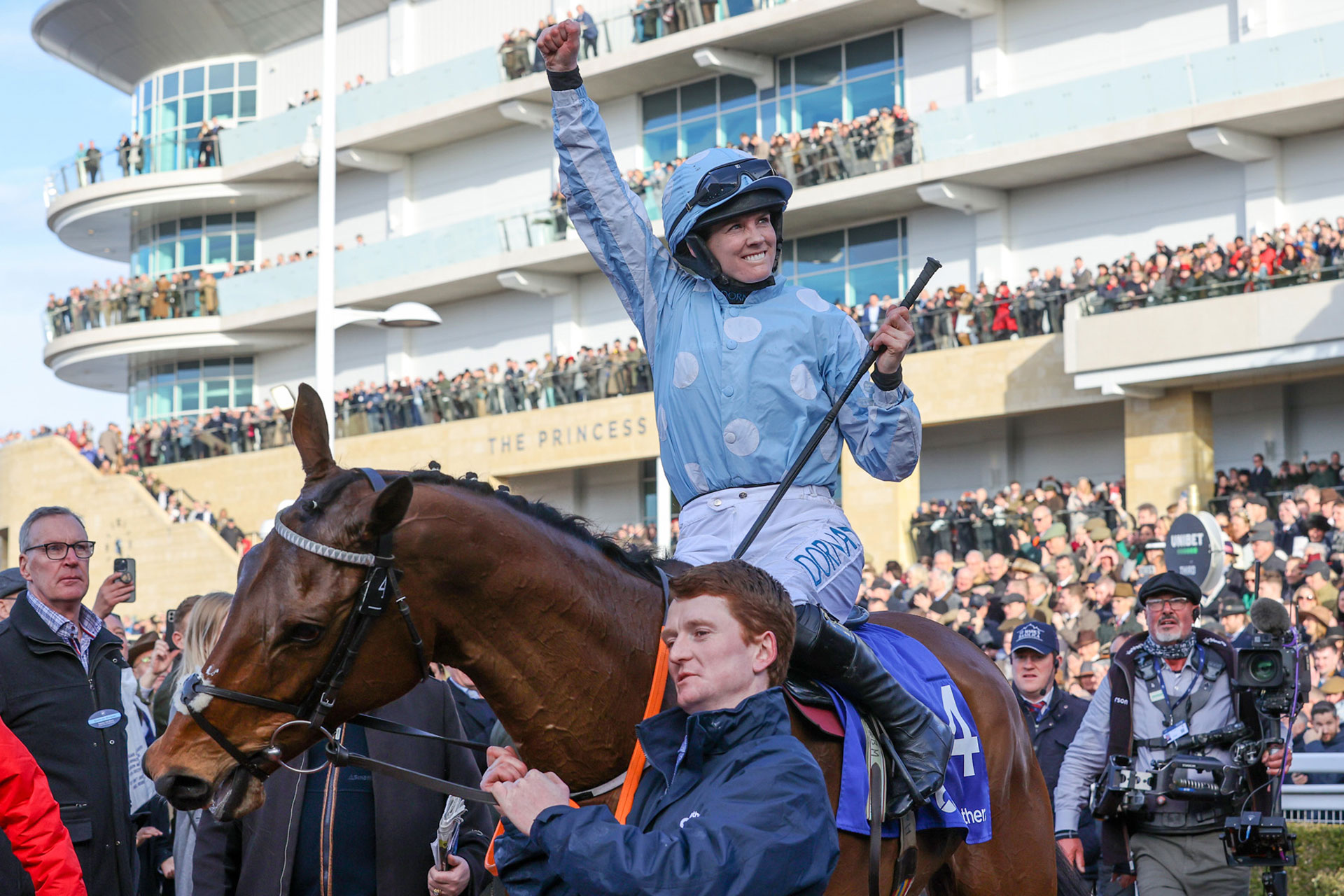
Honeysuckle
Honeysuckle
“You get letters from kids in the post and stuff and they’d ask about Honeysuckle. She was the one they wanted a picture of, or she was the one that they knew. She had a cool name as well. “I feel like our careers kind of grew together. Sure every jockey wants to land on something like her in their careers, and I got one.
“People know this now but she wouldn’t have been that friendly when you were in the stable with her. I didn’t ride her at home ever really. I would have schooled her before she ran but Colman Comerford used to ride her and she had different people looking after her through the years and Davey Roche overseeing everything.
“She wasn’t like Minella Times. You’d go in and give a cuddle to him. She didn’t have that vibe about her. But she’s so different now. I went to see her in Rathmore Stud, Peter Molony’s farm. Motherhood has changed her. She’s much different.
“The pressure riding Honeysuckle in general, it just grew every day. And the last day, you just wanted her to win. I wanted her to win so much, and everyone wanted her to win for just so much more than winning a race at Cheltenham. And I felt that off the crowd as we came back in. I have never experienced anything like that before.”
The mental titan
She was renowned for dealing with the Twin Imposters equally. Keeping it level.
“I think it’s hard to teach anyone that this is the way you need to think and be and prepare. I think you need to learn that yourself and find what works for you. I had a lot of practice early on of what it felt like (to lose). Had no success. So when things went wrong on the big stage, at least I had a good few years of knowing what that was like on a smaller stage. But everyone is different.
“I never had trouble sleeping the night before races. But the night after a race could be hard, because you’re either thinking about everything that went wrong and you’re worried about that, or you’re just on cloud nine.
“My favourite feeling is just when you wake up. You know that split-second when you don’t remember, and then you remember?
“When I won the National, we were meant to fly home that night, but I didn’t get my flight, so we stayed in this hotel. I woke up the next morning, and that split-second, you’re like, ‘Where am I? This is not my bed. What just happened at all?’ And then you’re like, ‘That all happened.’ It’s class. I’m really sad that I’ll never wake up anymore with that feeling. I’m gonna miss that.”